RefineX / Market Insights
Africa’s Gold Refining Expansion: Opportunities and Challenges for South Africa

In this article
Africa’s gold industry is undergoing a significant transformation as producing nations seek to retain greater economic value through domestic refining, processing and trading.
For decades, much of Africa’s mineral wealth has been exported for further processing. A growing commitment to local beneficiation could change these traditional supply chains, creating new industrial opportunities while increasing competition within the global precious-metal industry.
However, expanding refining capacity raises an important question: will these developments strengthen Africa’s position in international gold markets, or could excessive capacity create new commercial challenges?
For South Africa, the implications extend beyond gold production. They include competition for raw materials, refining profitability, international trade relationships and the future of regional precious-metal processing.
The expansion of African gold refining
Several West African countries, including Ghana, Guinea, Mali and Burkina Faso, are pursuing greater domestic participation in the gold value chain.
In August 2026, the Ghana Gold Board announced that self-financing gold aggregators would be required to refine gold doré domestically before export, effective from 1 September 2026.
The directive reflects a broader ambition to retain economic activity within producing countries rather than relying entirely on established overseas processing centres.
However, a Reuters report published on 24 November 2026 highlighted concerns about whether the industry’s expanding refining capacity could exceed available material supply.
This is where the distinction between industrial ambition and commercial sustainability becomes particularly important.
More refineries do not necessarily mean more gold
Gold refining infrastructure does not independently create additional gold supply. Its primary function is to process existing gold-bearing material into products suitable for further manufacturing, commercial transactions or bullion markets.
A refinery’s commercial sustainability depends on several factors:
- Consistent access to lawfully sourced material.
- Accurate sampling and assay procedures.
- Efficient processing and metal recovery.
- Competitive operating costs.
- Adequate working capital.
- Reliable settlement arrangements.
- Access to domestic and international buyers.
Where refining capacity increases faster than available feedstock, competition between processors could intensify.
This may result in more competitive purchasing terms for material suppliers, reduced processing charges and pressure on refining margins.
For newer operations, maintaining sufficient processing volumes could become one of their greatest commercial challenges.
In our view, access to sustainable material supply may ultimately prove more valuable than installed refining capacity alone.
What does this mean for South Africa?
South Africa has an established position within the precious-metal industry, supported by extensive mining experience, metallurgical expertise, analytical infrastructure and international commercial relationships.
The LBMA’s review of South Africa’s recycling and refining industry identifies Rand Refinery as a major participant in the processing of regional gold mine supply.
As other African countries develop their own facilities, South Africa may experience both opportunities and increased competitive pressure.
Opportunities for South African businesses
Emerging refining operations could create demand for South African technical expertise, analytical services, specialist equipment, training and metallurgical support.
Opportunities may also arise through regional commercial partnerships, specialist processing arrangements and the development of more diversified supply chains.
South African businesses could increasingly explore secondary precious-metal sources, including jewellery workshop residues, industrial materials and qualifying electronic waste.
These materials present opportunities beyond conventional mine-produced gold, particularly where specialised assessment and recovery capabilities are required.
Greater regional competition may also encourage improvements in technology, recovery efficiency, customer service and commercial transparency.
Challenges facing the local industry
If more gold is processed within its country of origin, established South African refiners could face increased competition for imported material.
Reduced processing volumes could place pressure on operating margins, particularly for businesses with substantial fixed costs.
Other commercial challenges may include access to working capital, electricity costs, regulatory compliance, logistics and the ability to provide competitive purchasing and settlement arrangements.
South Africa’s established industry experience remains an advantage. However, maintaining that advantage will require continued investment in operational efficiency, technical capability and customer confidence.
Potential implications for international gold markets
Increased African refining capacity could gradually influence the geographical distribution of gold processing and international trade.
Producing countries may develop more direct relationships with international buyers, financial institutions and precious-metal trading businesses.
This could reduce reliance on certain established processing centres while creating alternative commercial routes.
However, producing refined gold and achieving widespread international market acceptance are separate challenges.
Recognised product standards, responsible sourcing, independent verification and established commercial relationships remain important factors in determining market access.
In our opinion, the future may involve a more geographically diverse refining industry rather than the complete displacement of existing international processing centres.
Established and emerging refineries could increasingly operate as competitors, customers and commercial partners within the same global supply chain.
Understanding the current gold market
The World Gold Council’s third-quarter 2026 report provides useful context for assessing these developments.
| Market indicator | Q3 2025 | Q3 2026 | Annual change |
|---|---|---|---|
| Gold mine production | 1,040.7 tonnes | 1,070.9 tonnes | +3% |
| Recycled gold | 342.7 tonnes | 314.5 tonnes | −8% |
| Central banks and other official institutions | 226.3 tonnes | 321.2 tonnes | +42% |
Source: World Gold Council, Gold Demand Trends Q3 2026. Percentage changes are rounded.
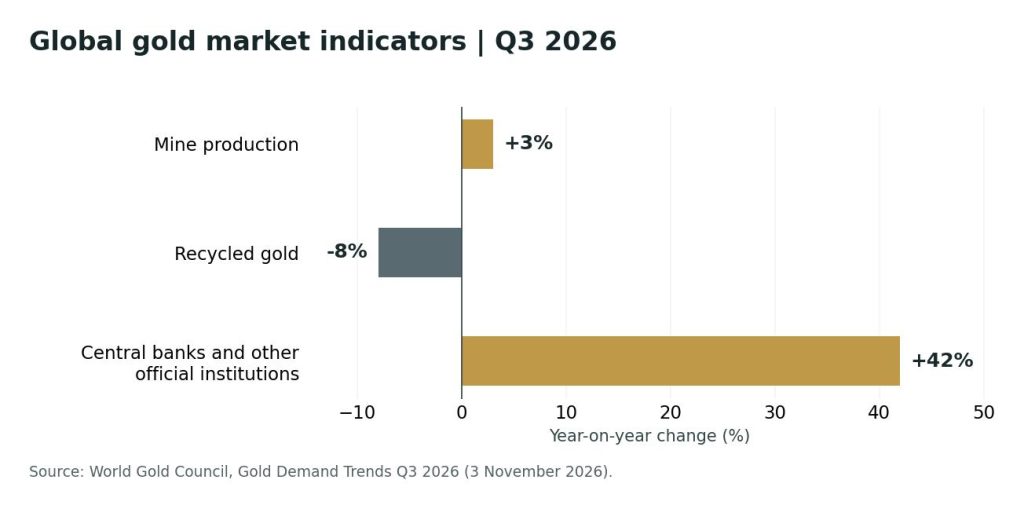
The figures illustrate how different market forces can operate simultaneously. Mine production increased, recycling declined and central bank demand strengthened during the same reporting period.
For the refining industry, these developments are particularly relevant because metal prices, physical material availability and processing profitability do not necessarily move in the same direction.
Could these developments push gold prices higher or lower?
The international gold price is influenced by a combination of economic, monetary, geopolitical and physical supply factors.
African refining expansion alone is unlikely to determine the direction of global gold prices. Its greater immediate influence may be on regional material availability, purchasing competition, processing charges and commercial margins.
Nevertheless, broader developments associated with the expansion could contribute to changing market conditions.
Potential upward price pressures
Factors that could support higher international gold prices include:
- Continued central bank accumulation.
- Increased demand during economic or geopolitical uncertainty.
- Strong institutional investment demand.
- Constrained growth in mine production.
- Lower availability of recycled gold.
If producing countries increase their domestic gold reserves, additional purchasing demand could also influence the availability of metal within certain commercial channels.
The significance of this effect would depend on its scale relative to the global market.
Potential downward price pressures
Factors that could contribute to lower gold prices include:
- A strengthening US dollar.
- Higher real interest rates.
- Reduced institutional investment demand.
- Increased mine production and recycling.
- Weaker jewellery and industrial demand.
Improvements in recovery technology could also increase the quantity of marketable gold recovered from existing materials.
However, relocating the refining of existing gold from one country to another does not automatically increase global supply or reduce international prices.
The impact of exchange rates on South African gold values
South African businesses must consider both the international gold price and the exchange rate between the rand and the US dollar.
A decline in the international gold price does not necessarily translate into an equivalent decline in rand-denominated gold values.
| International gold price | Rand movement | Potential local impact |
|---|---|---|
| Rising | Weakening | Stronger upward pressure on local gold values |
| Rising | Strengthening | International gains may be partially offset |
| Falling | Weakening | International losses may be partially offset |
| Falling | Strengthening | Greater downward pressure on local gold values |
These relationships are particularly important for businesses purchasing precious-metal-bearing material, calculating processing returns or managing international commercial transactions.
Actual settlement values will also depend on metal content, recovery, applicable charges and agreed transaction terms.
Three possible outcomes for the refining industry
1. Sustainable African expansion
New refining operations secure sufficient material supply, develop recognised quality standards and establish reliable international commercial relationships.
This could support employment, industrial development and greater retention of economic value within African producing countries.
2. Excess refining capacity
New processing facilities compete for insufficient volumes of material.
This could lead to tighter refining margins, aggressive commercial competition, reduced capacity utilisation and potential industry consolidation.
3. Greater regional collaboration
Established and emerging African refiners develop complementary processing capabilities, technical partnerships and commercial relationships.
This could strengthen regional supply chains while allowing specialist businesses to participate in different stages of the precious-metal value chain.
These outcomes are not mutually exclusive. Different markets may experience elements of all three scenarios.
Responsible sourcing and commercial transparency
As competition for precious-metal-bearing material increases, responsible sourcing and transparent commercial practices become increasingly important.
The LBMA Responsible Gold Guidance provides an international framework for risk-based supply-chain due diligence.
Reliable sourcing records, customer verification, accurate assay procedures and clearly defined settlement terms are important components of a sustainable precious-metal industry.
Commercial pressure should never come at the expense of lawful sourcing, regulatory compliance or professional accountability.
The RefineX perspective
We believe Africa’s expanding gold refining industry presents a meaningful opportunity for regional industrial development.
However, the success of this expansion should not be measured solely by the number of refineries constructed or the volume of installed processing capacity.
It should be measured by the industry’s ability to secure sustainable material supply, achieve reliable recovery, maintain responsible commercial practices and create lasting economic value.
South Africa should not necessarily regard emerging African refining centres exclusively as competitors. They may also become future customers, suppliers and technical partners.
The businesses best positioned to navigate these developments may be those capable of combining technical expertise, transparent commercial arrangements and adaptability.
Ultimately, Africa’s opportunity lies not simply in producing or refining more gold, but in building a stronger and more integrated precious-metal value chain.
Discuss your precious-metal requirements with RefineX
RefineX welcomes local and international commercial enquiries concerning qualifying precious-metal materials, assay, refining, recovery, purchasing and trading.
Explore our services or contact RefineX to discuss your material and commercial requirements.
For further practical information, read our guide to assay, toll refining and outright purchase, our guide to preparing a refining enquiry and our customer acceptance terms.
References and further reading
- Reuters: West Africa’s rush to refine its own gold unleashes flood of capacity, 24 November 2026.
- Ghana Gold Board: Mandatory local refining of gold doré before export, August 2026.
- World Gold Council: Gold Demand Trends Q3 2026, 3 November 2026.
- World Gold Council: Gold Market Outlook
- LBMA: Spotlight on the South African Market, Recycling and Refining
- LBMA: Gold Good Delivery Current List
- LBMA: Responsible Gold Guidance Version 9
Disclaimer
This article represents RefineX’s independent industry commentary and interpretation of publicly available information as of 26 November 2026.
It is provided for general informational and educational purposes and does not constitute financial, investment, legal or trading advice.
The potential market developments and scenarios discussed are opinions and hypothetical outcomes, not predictions or guarantees of future prices, commercial performance or investment returns.
Readers should conduct their own research and obtain appropriate independent professional advice before making financial or commercial decisions.
References to third-party organisations do not imply affiliation, accreditation, partnership or endorsement of RefineX.
Featured image: original AI-generated editorial illustration, not a photograph of a specific facility or a depiction of verified trade routes.